





Image

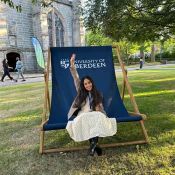
I remember before coming to the UK, a lot of challenges came my way, and I doubted whether this dream was really meant for me. Still, I kept going, every time more tired than before, but something inside me kept pushing me forward. I think of the multiple times Across the Pond helped me — it felt like we were connected, because every time I was about to give up, I'd receive an email from them with useful information, or simply asking how everything was going. I recommended Across the Pond to one of my best friends, because I genuinely found them while navigating the internet, and I feel they were a key piece in helping me get to study my Master's in IT with Cybersecurity at the University of Aberdeen. It was a long process, as I applied to multiple universities while working out my strategy for how I would pay for everything and looking into scholarships. I didn't know much about scholarship options at the time, and Across the Pond guided me through it really well. Thanks to their support, I secured the FIDERH loan and the SECIHTI scholarship to study in the UK.
Once I arrived in Scotland, I remember the first day I got to my student accommodation. My bedsheets hadn't arrived on time, and since I'd arrived a few days early, everything was completely silent. That day was one of the scariest of my life — I was terrified about leaving everything behind and starting from scratch. Even though I had lived in different cities in my country and had spent time abroad in the USA, this felt different, because for the first time in my life, I was truly alone. Looking back, this is something I wish I had known more about before arriving: there were other student accommodation options available, some requiring far less paperwork, that would have made those first few days feel much less overwhelming.
After that, I started my classes, and I remember them being quite challenging at the beginning. In Mexico, classes tend to be structured differently, and the amount of self-study expected here was no joke — it took me a few weeks to adjust. But once I found my rhythm, I really got into the flow of studying, and I found myself researching things even outside the scope of my course, purely out of curiosity to understand how they worked. The programme at my university was genuinely well designed. I hadn't studied IT during my undergraduate degree, but I had developed a passion for it and built my career around it, even though I'd never formally studied much of the underlying theory. This programme helped connect a lot of things from enterprise IT that I hadn't fully understood before, and combined with my chosen specialization — cybersecurity — everything started coming together. I became genuinely passionate about building things, and as part of my dissertation, I built a multi-domain, AI-enhanced application security scanner for the University of Aberdeen.
Around the same time, in November, I found an Automation Developer internship opportunity. I applied and got the job — I remember how happy I was when I received the news, because I had studied so hard for that interview. This was a 9-month placement within the Microsoft development team at the University of Aberdeen, and it truly was an experience that taught me a lot. My goal in coming to the UK was to gain more hands-on technical experience, and I worked alongside colleagues from Scotland, Pakistan, and Russia, which made the experience even richer in terms of culture and different ways of working.
Yesterday was my goodbye party with my girlfriends — women I met from all around the globe: India, Bangladesh, Pakistan, Spain, Letonia, the USA, and Mexico. That was one of the most precious parts of this whole experience. They helped me understand the world in a completely different way than I could have imagined before, and I feel like I've carried a small piece of each of their mindsets into my own life, shaping how I now see the world.
Today marks one year since I arrived in the UK. Looking back at this whole process — the fear I felt on that first day, the sadness of missing my family — I can't feel anything but happy, proud, and thankful. Thankful for all the opportunities this country gave me, and for everything I learned during those long hours in the library. This experience is one I poured more effort into than anything before it, and that same effort is what continues to push me to keep crossing barriers, reminding me that I can achieve anything I set my mind to. All I needed was hard work, perseverance, and a bit — or perhaps a lot — of life's magic: family who supported me, people I met along the way who became my family too, real opportunities, a country that opened its doors, and, in the end, life aligning itself when you want something so badly you can feel it in your chest.
This experience was priceless, and none of this would have been possible without the help of Across the Pond, who were there every step of the way, making everything so much easier and more approachable, always guiding me toward my dream.
Thank you for everything, to everyone, and to the world.
- Diana Laura

My move to Scotland didn’t feel real until I stepped into Aberdeen Airport, fresh from a 9.5-hour flight from Toronto. I staggered off the plane and walked towards baggage claim. Alone. I felt tired, thirsty, and completely unprepared for my journey ahead. I recalled the long hours editing personal statements, corresponding with references, and gathering writing samples. At the time, I thought nothing was more arduous than my postgraduate applications. But in hindsight, pressing “submit” was the easiest part of the process. Cramming my life into two suitcases, on the other hand? Quite the challenge.
Nothing truly compares to the experience of entering a new city. The world feels fresh and uncharted. Despite my sudden dose of reality, I couldn’t wait to begin my adventure in the UK. The first item on my To-Do list? Visiting the University of Aberdeen, A.K.A. my home for the next year.
The King’s College campus greeted me with weathered brick buildings and climbing ivy as I walked through the gates for the first time. Founded in 1495, the University of Aberdeen is the third oldest university in Scotland and the fifth oldest university the UK. If you have no other motivation to study in the UK, the cozy old-world charm of the universities ought to be a strong starting point.
Since moving abroad comes with a long checklist, finding an affordable student flat should not be your top priority. To save myself the hassle of house-hunting, I opted for off-campus student accommodation. Fortunately, the University placed me in a complex with other postgraduate students, making it easy to meet people with likeminded interests.
I arrived in Scotland one week before my check-in date, which is something I highly recommend. With one week to spare, I had time to overcome my jetlag, shop for items that wouldn’t fit in my suitcase (i.e. raincoat, bedding, stationary), and travel around Scotland. By the time I moved into my flat, I had already adapted to the groove of Aberdeen.
The University kicked into gear with Fresher’s Week on the day I moved in. Many events and activities are targeted towards undergraduates; however, all students are welcome to enjoy the many offerings of free food, live music, and poster sales.
Fresher’s Week also included promotional fairs, such as the “Societies Fayre” and “Sports Fayre.” During these events, student societies and sports teams arranged booths on campus for students to browse around and sign up. I can’t speak for every UK university, but societies and teams are a major component of student life at the University of Aberdeen. They can be a great way to meet new friends, so I definitely recommend attending Fresher’s Week for these initial meet-and-greets.
On Orientation Day, I was pleasantly surprised to learn that my program only consists of seven other people. Postgraduate programs in the UK are typically quite small, so you quickly become close with your classmates. The class structure, however, required more adjusting. For me, classes occur in blocks, with each class running back-to-back for three week intervals. This system has its pros and cons.
Con: Three weeks of intensive reading, lecturing, and studying.
Pro: No exams in December!
I won’t pretend that moving overseas is easy. I felt displaced for two weeks before I began to acclimatize and feel at home. But these initial feelings shrink in comparison to the people you’ll meet, the places you’ll visit, and the lifelong memories you’ll create.
- Hailey

Time passes quickly in Aberdeen. The leaves drop without warning and the sun sets earlier every day. It’s hard to believe that two months have passed since the beginning of the semester. I’ve submitted essays, worked on group projects, and given presentations. Yet, I still feel as if I only arrived last week.
I study an MSc in Professional Communication. The program combines linguistics and business, offering a practical approach to the science of communication. Prof. Comm. students learn to communicate effectively across disciplines – a feature that attracted me to the subject. Like any communications program, Prof. Comm. teaches skills that are invaluable and applicable to almost every field of study.
Jim Rohn said, “Take advantage of every opportunity to practice your communication skills so that when important occasions arise, you will have the gift, the style, the sharpness, the clarity, and the emotions to affect other people.”
Like many 22-year-olds, my career is still up in the air. I’ve toyed with the ideas of writing, editing, journalism, and public relations. Sadly, no degree combines all of these areas.
Communications is a perfect option for people like us – those who haven’t quite made up their minds yet. I don’t imply that you should use a communications degree to kill time. Rather, you should study communications to add depth to your career. The subject is universal and timeless. You can bring these skills to any job, now or in the future.
Without a doubt, writing is my vocation. Yet, the idea of a full-blown communications degree appealed to me. Even if you have a strong understanding of your professional interests, communication is an extremely practical tool to have on your resume. It complements every field – you can’t go wrong.
Communication is always relevant, no matter the country. That being said, I believe you have more to gain from studying communications in a new country. Here’s why:
Studying in the UK expands your travel options tenfold. Cheap airlines, trains, and busses offer you the opportunity to explore Europe on a student budget. Spain for the weekend? Sure. Edinburgh for lunch? No problem.
Program length is also a major contender for studying in the UK. In Canada, Master’s programs usually last two to three years, full-time. But in the UK, your Master’s will only take one year to complete. Studying in the UK is a great way to accelerate your degree if you want to enter the workforce faster.
Undergraduate degrees require you to take several courses at once – typically, full-time students take 4 or 5 a semester. But in my program, I’m only required to study one course at a time. The classes run back-to-back: I have three classes each semester and my final dissertation over the summer.
Naturally, program structures shift from undergraduate to graduate levels. A full-time Bachelor’s student will take a variety of different electives, on top of their required program courses. In my opinion, Master’s degrees are more efficient; I’m only required to take program-specific classes. You might discover that graduate classes demand more effort. However, you end up with more spare time, so your schedule balances out in the long-run.
Time drags when you choose a program or university out of convenience. Don’t settle. Make decisions that will lead to your happiness. Make decisions that will make the months feel like minutes.
- Hailey
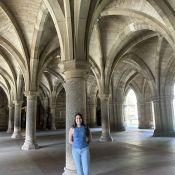
I am originally from Mexico City, and for a long time I knew that I wanted to pursue a master’s degree in International Intellectual Property and Information Law in the United Kingdom. My goal was to specialize in an area I am passionate about while also opening doors in a global work environment. That is why I decided to study in the United Kingdom, not only because of the great reputation of its educational system but also because I wanted to experience studying in a country where English is spoken, a language essential for my professional development in Intellectual Property.
I chose the University of Aberdeen because its program is innovative, modern, and very well-structured, in addition to having an excellent faculty team. However, I knew that achieving this dream would require not only dedication and effort but also financial resources. And that’s where I discovered FIDERH, one of the best decisions I could make.
At first, the idea of financing my studies made me somewhat nervous. However, I soon understood that investing in your education is investing in yourself, and that having support like FIDERH makes the process much simpler and more accessible. Without hesitation, I can say that FIDERH is one of the best financing options available in Mexico for those of us who want to study abroad.
The application process is clear and organized: you just need to gather the required documents and meet the established deadlines. Therefore, organization is key to successfully applying for and obtaining this financing. In addition, the amount they finance is significant, covering an important part of tuition and living expenses. In my case, I complemented the financing with my savings, and it was enough to cover my needs during the master’s program. If you need additional funding, there are many other options that can complement it and are also manageable to repay, such as FUNED.
One of the aspects I value most about FIDERH is that, upon finishing your studies, it grants a one-year grace period before you start payments. This allows you to find employment calmly and plan your personal finances. Furthermore, once you begin repayment, the term to settle the loan is up to 10 years, which allows you to manage the monthly payments calmly and without unnecessary pressure. Even the interest rate for late payments is low, providing even more flexibility and security. Of course, you can also pay it off much earlier than 10 years if you prefer.
Another great advantage of FIDERH is that many universities, such as the University of Aberdeen, have agreements with Mexico and offer up to a 20% discount on tuition if you have this financing. This represents a considerable saving and makes the option even more attractive and viable.
You should see your master’s degree as a long-term investment. In my case, shortly after completing my studies, I began receiving job offers from firms specializing in Intellectual Property in Mexico through LinkedIn. Having a degree from a recognized foreign university greatly increases your professional projection, and with a good position, it becomes much easier to repay the financing in a short time.
If you are considering applying, I want to share some practical tips that made my process easier:
Certificate of No Liens: This can be a complicated process and may take some time depending on the region where the property is located. In my case, I delegated it to a notary to speed it up since it is not very expensive. It is important to request the physical version, as FIDERH does not accept digital certificates due to the lack of a handwritten signature.
Credit Bureau Report: This document is essential and must be submitted for both you and your guarantor. In theory, it is easy to process, but in my case, I faced several issues. I had moved, and although I had updated my information at the bank, the institution did not reflect it correctly, so the report could not be generated. Additionally, when I tried to obtain my guarantor’s report, an additional problem arose: their name and compound surname matched those of their child, and the information was mixed in the system, preventing the correct report. This taught me that you must start this process well in advance, check that all personal information is correct, and if necessary, go directly to the institutions to resolve any errors.
Unconditional Letter of Acceptance from the University: FIDERH requires an unconditional acceptance letter. Therefore, it is important to apply first to the universities of your interest and meet their requirements, such as the IELTS exam, well in advance.
Apply in the First Call: There are fewer applicants, which increases your chances of being approved, and it will allow you to calmly plan other procedures, such as finding accommodation, knowing that you already have this financial support.
Talk to Your Guarantor from the Start: Explain the benefits of the financing and, very importantly, clarify that the property presented as collateral is not encumbered, which provides peace of mind.
Use the Support of Across the Pond: This help was essential for completing all my procedures with FIDERH. They are experts in the process, always have the best advice, and are willing to resolve any questions or difficulties that arise. They are very attentive, kind, and capable professionals, true dream enablers, who make the entire process much clearer and more manageable.
Thanks to FIDERH and the support I received from my advisors at Across the Pond, I was able to take the most important step of my career: studying my master’s at the University of Aberdeen. While it involves preparation, procedures, and organization, it is completely worth it. Do not be afraid to finance your education; with FIDERH, you receive real support, extended terms, and accessible conditions, unlike many other financing options with less favorable conditions for the beneficiary, such as excessively high interest rates or very short repayment periods.
My recommendation is clear: lose the fear of financing with FIDERH. If you work with discipline, stay informed, and seize opportunities, this support will become the engine you need to achieve your academic and professional goals and take a huge leap forward in your development.
- Paola

For Christmas I decided to escape from the routine of Aberdeen to explore Edinburgh and its Christmas market for 3 days. What began as a spontaneous idea became a very beautiful trip. The cobblestone streets, its medieval architecture, the Christmas decorations and its vibrant culture, Edinburgh captivated me from the first moment.
To get from Aberdeen to Edinburgh I had two main options: train and bus. After comparing prices and schedules, I opted for the train, which turned out to be an excellent decision. The journey lasted approximately 3 hours, and the cost of the round-trip ticket was £45 with the rail card (a card that gives you discounts on train tickets). The bus alternative would have been more economical (around £25 round trip), but with a duration of almost 4 hours, I preferred the comfort and speed of the train.
One of my biggest concerns was the cost of accommodation, since Edinburgh has a reputation for being one of the most expensive cities in the United Kingdom. After searching various options, I found a hostel in the historic center for £53 per night in a shared room. For those who prefer more privacy, hotels located in the historic center in the new part of the city ranged between £85-£120 per night, while hotel chains further from the center offered rates from £60.
I decided to stay at the Kick Ass hostel, located just five minutes' walk from Edinburgh Castle. Although the facilities were basic, the location was unbeatable and the atmosphere was very welcoming, with tourists from all over the world sharing experiences in the common room.
Among the main attractions I visited, my first stop was the iconic Edinburgh Castle. The entrance cost £19.50, but it was worth every penny. Walking through its ancient walls transported me centuries back. The panoramic view of the city from the ramparts is simply spectacular, especially at sunset when the city lights began to shine.
My second stop was the famous Victoria Street, known worldwide as the inspiration for Diagon Alley from Harry Potter. Walking down this cobblestone and winding street was like entering a magical world. The colorful shops with their medieval facades and boutique stores created a unique atmosphere. I spent more than an hour exploring the shops, especially those dedicated to Harry Potter items and Scottish souvenirs.
After that I walked the famous Royal Mile. This historic street, which connects the castle with the Palace of Holyroodhouse, is full of souvenir shops and traditional pubs, which offer an excellent opportunity to experience the Scottish atmosphere.
The Christmas market was undoubtedly one of the most beautiful places of the trip. This market, considered one of the best in the United Kingdom, extended like a labyrinth of small wooden houses decorated with bright lights and Christmas decorations. The aroma of spiced mulled wine, roasted chestnuts and traditional Scottish sweets could be felt in every corner. I spent hours exploring the stalls, where I found everything from local crafts to culinary delights. I tried the famous Scottish shortbread, bought some unique handmade gifts and enjoyed a cup of mulled wine that helped me combat the winter cold.
Dean Village also turned out to be one of the most pleasant surprises of my trip. This small historic village, located just a few minutes from the city center, seems taken directly from a medieval movie. You can see several stone houses that are located next to a river which makes the landscape look more beautiful.
Edinburgh exceeded all my expectations. The Christmas atmosphere and Scottish hospitality were felt in every corner of the city. This trip reminded me why I love living in Scotland. Having access to gems like Edinburgh just a train ride away is a privilege I don't take for granted.
Edinburgh is not just a city to visit; it's an experience to live, a history lesson walking through its streets, and a reminder of the rich cultural heritage that characterizes Scotland.
- Paola
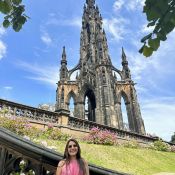
When I decided to study in the United Kingdom, I knew that this opportunity meant not only a quality education, but also the unique possibility of exploring one of the countries with the greatest historical and cultural richness in Europe. During my stay in the United Kingdom, I have managed to organize my time to visit fascinating cities that have deeply enriched my personal and academic experience.
My experience has taught me that timing is fundamental to making the most of travels throughout the United Kingdom. The summer months, especially from June to August, became my favorites for traveling, as during these dates, the days are considerably longer, and the weather is warmer. However, I also discovered the special charm of traveling during university vacation periods in spring and autumn. In April and May, the gardens are in full bloom, and August-September offers pleasant temperatures with fewer tourist crowds.
One of the smartest decisions I made was acquiring a Railcard at the beginning of my stay. This card, which costs £30 annually, provided me with discounts on all my train journeys. Considering that a trip from Aberdeen to London can easily cost £85, the card paid for itself after just three long trips.
The flexibility it gave me was invaluable. I could make spontaneous travel decisions during weekends, knowing that transportation costs would be significantly lower.
One of the most costly mistakes I almost made was planning trips without considering the country's geography. Initially, I thought of visiting London, then Edinburgh, then Bath, and finally Liverpool. This route would have meant constantly going back and forth across the map, doubling my transportation costs and travel time.
Instead, I developed a "linear routes" strategy that saved me considerable money and time. For example, one of my most successful routes was: London → Oxford → Bath → Birmingham → York → Edinburgh. This sequence allowed me to explore systematically, visiting each city along the way without backtracking, and also allowed me to gradually observe the cultural and landscape changes of the country, from the cosmopolitan cities of the south to the dramatic Scottish landscapes.
My travel strategy was completely adapted to my academic calendar. Long weekends became perfect opportunities to explore nearby cities. From my base in Aberdeen, I could take full-day trips to Dunnottar Castle or Glasgow in the same day.
For more distant destinations like England, I reserved the longer university holidays. This planning allowed me to completely immerse myself in each region without the pressure of returning quickly to my studies.
Studying in the United Kingdom gave me much more than an academic education; it offered me an incomparable window to explore centuries of history, from the Roman walls of York to the medieval castles of Dunnottar. Each trip complemented my formal education, providing me with experiences I will always remember.
The key to success was treating these trips not as a distraction from my studies, but as an integral extension of my educational experience. Each city visited added a new dimension to my understanding of British culture, its history, and its regional diversity. At the end of my program, I will not only obtain an academic degree, but also a deep appreciation for the cultural richness of this extraordinary country and memories that I will treasure for life.
- Paola
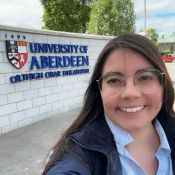
Since childhood, I have been passionate about acquiring new knowledge and, over the years, I discovered Intellectual Property Law as a fascinating field that connects creativity, innovation, and legal frameworks. However, I knew that in order to grow professionally, I needed education of an international standard. That is why I decided to take a major step: leaving my beloved Mexico City to pursue my dream of studying a Master’s in International Intellectual Property and Information Law.
I chose the UK because its education system is internationally recognised for its excellence, but also because I wanted to experience studying abroad and immerse myself in a culture and language different from my own. Improving and perfecting my English was a key factor in my decision, as it is the global language of communication, essential for Intellectual Property Law, international business, and collaboration with colleagues worldwide.
The University of Aberdeen (UoA) captured my interest from the very beginning. With over five centuries of history and an outstanding cultural and academic heritage, it offers a cutting-edge master’s programme designed to integrate the essential foundations of law with the latest developments in Intellectual Property, Information Technology, Data Protection, and Privacy.
The teaching staff is truly exceptional. They are academics who not only teach but also lead international research, publish influential books and articles, advise governments, and collaborate with global organisations such as the World Intellectual Property Organization. One of the main reasons I felt inspired to study at UoA was their interdisciplinary project, “Sharing the Benefits of the Ocean”, which explores how marine resources can be utilised sustainably and equitably, combining law and marine biodiscovery chemistry. This kind of initiative highlights the University’s commitment to practical and impactful learning that goes beyond the classroom.
Additionally, the University offers a highly personalised approach to education. From the virtual open day events, which allowed me to explore the campus and community, to the direct contact with lecturers and students, I always received quick and helpful responses. On top of this, the University’s excellent rankings, top 15 in the UK according to the Times and Sunday Times Good University Guide, top 3 in Scotland according to the Guardian Guide, and number 1 in Scotland, Wales, and Northern Ireland for student satisfaction according to the National Student Survey, confirmed that Aberdeen was the perfect choice for me.
One of the greatest gifts of this experience has been the cultural diversity. Studying in Aberdeen means interacting with people not only from the UK but from all over the world: Thailand, India, China, Japan, Poland, Nepal, Ireland, Russia, the United States, Spain, and many more. These classmates, who have undoubtedly become close friends and colleagues, have allowed me to learn first-hand about different traditions, customs, and perspectives.
Having a supportive group of Latin American friends (from Mexico, Paraguay, and Colombia) has also been invaluable. We share challenges, celebrate achievements, and accompany one another throughout this journey, creating a network of friendships that I know will last a lifetime.
Aberdeen is a safe, welcoming, and vibrant city. It offers the best of both worlds: a peaceful environment ideal for focusing on studies and a lively social life with cultural and social events, bars, clubs, and beaches. The Aberdeen Sports Village is another highlight, offering modern and affordable facilities for swimming, squash, football, pickleball, badminton, and many other sports.
One of the things I love most is that, due to its northern location, Aberdeen offers the unique opportunity to witness the Northern Lights. Moreover, it is one of the safest cities in the UK, having been awarded the prestigious Purple Flag for its safety and security ten years in a row. For me, as a woman, living in a place where I can feel safe even at night is priceless. On top of that, Aberdeen is significantly more affordable than many other UK cities, which allows me to save money for travelling and exploring other incredible parts of Europe.
Of course, the journey has not been without its challenges. Being far from home and living on the other side of the world has not been easy, and the cold weather has been quite an adjustment for someone from Mexico City. However, with thermal clothing, a good waterproof coat, and proper footwear, I’ve learned to embrace and even enjoy it. While the long, dark winters can be demanding, sharing experiences with friends and gaining new knowledge makes every day worthwhile. On the other hand, Aberdeen’s summer is absolutely magical, the sun rises as early as 2 a.m. and sets after 10 p.m., offering endless daylight and unforgettable memories.
Finally, I want to dedicate this space to express my deep gratitude to the Across the Pond team and, in particular, to my advisors. Thanks to their expert guidance, the entire process, from selecting and applying to universities, securing financing through FIDERH, to obtaining my student visa, was much smoother and clearer. Their support was key to achieving my goal, and I wholeheartedly recommend them to anyone dreaming of studying in the UK. Thank you for helping me make my dreams come true!
- Paola
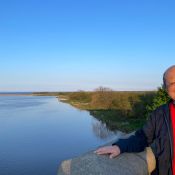
I began my journey with a trip full of surprises, delays and a lot of stress. I arrived to Aberdeen (The Silver City!) to a winter where day was night. I stayed in a hotel for a couple of weeks, then I went to Hillhead.
Classes started in February. I arrived with a mind full of (boring) political analysis methodologies, but suddenly new ideas began to emerge. Universes, characters, and plots were born. Furthermore, I shared my creations with friends from other countries and forged an eternal bond of joy and the same desire to write our stories. However, not everything was easy.
Also, I travelled to another places in Alba or Scotland. I learned that the Highlanders are beautiful people, with many stories of sacrifice and joy at the same time. I watched the sun covering the Cairngorm Mountains and Loch Ness (not Nessie, sadly), walked through Aberdeen, Dundee, Glasgow and Edinburgh.
On that trip, I met friends, new writers, and magical places plenty of history…and stories. But I can't lie. I faced an economical hard scenario. You must know, the cost of living is high, and the weather is a little complex for people from warm lands. Also, there is a growing social tension and there may be fear. Fear? Friends, fear can be fought and overcome. I travelled to the United Kingdom very young, at my 52 years old, with a lot of savings.
I returned to Chile, penniless, unemployed and alone. But....fear? The fear ended when a few months later I found, thanks to the same will with which I went to the United Kingdom, three jobs, in Chile. I know that my country is now complex to rebuild me a professional.
Nevertheless, don't be afraid, save money and keep the desire to live, to know the origin of new universes in your professional life! Cross the pond, you are younger than me and your decisions are infinite.
A hug and my best wishes on your journey. They are going to the United Kingdom or perhaps also to Scotland! In my case I was physically born in Chile, but my soul in the highlands.
Have a good trip and cross the pond, travelers of knowledge.
- Raul

One of the best decisions of my life was to come to study at the University of Aberdeen in Scotland.
I had been working as a statistician for 14 years in Chile and although I liked my job and my life I felt that something was missing. After a year of thoughtful consideration I realised that what I wanted was to dedicate myself to writing. And that's when the doubts and fears flooded me. Where do I start? Do I study a career or just write something? In my country or abroad? And if I go outside Chile, where do I go? Will I have what it takes to pass my studies? Will I have enough money? Will it be worth the risk at 46 years old?
I chose to study an MLitt in Creative Writing in the UK because their curricula were more practice-oriented than academic. And of all the universities I researched and whose Virtual Open Days I attended, Aberdeen seemed to be the closest to the students and willing to give us all the necessary tools to successfully carry out our studies and at the same time nourish us with an enriching social and cultural life. In addition, my MLitt professors were very experienced in their respective fields, so their lectures and feedback on my work were invaluable, as was their constant support and encouragement.
During the Welcome Week the University deployed a myriad of activities aimed at helping us, new students, to feel welcome and included, and also to guide us both academically and on a day-to-day basis. Thanks to all this organisation I was able to open my university email account, learn how to use the MyAberdeen platform (where much of the university's information is hosted as well as the courses I studied), get the necessary documents to open a bank account, sign up for a talk on how to open a bank account, signed up for a talk on how to manage our finances efficiently, took a tour around the campus (which is itself a monument, with over 500 years of history) and its surroundings (the local bookshop, cafes, pub, botanic garden, etc.) as well as the state-of-the-art library; I joined the Yoga Society and the Creative Writing Society, attended the WayWord literary festival and workshops for free, had a membership to the sports village, went to coffees and BBQs organised by AUSA (Aberdeen University Students' Association) where I met students from other majors and various nationalities. At the same time, the School of Language, Literature, Music and Visual Culture organised a meeting for the students to get to know the professors of the School and our fellow students, and also to orient us about which courses to take and how to enrol in them.
During the year I studied my MLitt I had the opportunity to have a personal tutor, to go to the student association whenever I needed them and to access the careers and employability service that advised me in my job search (CV, interviews, etc.). I enjoyed preparing my thesis and graduated with commendation.
In this year I met my current partner and two great friends with whom we keep in regular contact even though we are now in countries as different as they are distant. With them I went to concerts, restaurants, pubs, plays, standup comedy, films, parties, castles, Highland Games, picnics on the beach, hikes in the mountains, among others, both in Aberdeen and the rest of Scotland.
I will not deny that coming to a new city, in another language (and adapting to the Scottish accent), studying again, being away from my family and friends was a bit overwhelming at first. Insecurities and apprehensions were very present when I arrived in the UK. However, all of that was made more bearable not only with the support of the university but also because they foster an environment of inclusion, learning and cultural exchange where all of us who studied here were willing to get to know each other, to accompany each other and to create community.
Almost a year after graduating, I can't help but smile every time I remember my time at the MLitt, my heart races with joy and I am certain that this was one of the best decisions of my life because it has brought me much happiness.
- Claudia
Where do you live when studying abroad? Do universities in the UK offer student housing? How much does student accommodation cost? Did you know that as an international student, you are guaranteed on-campus accommodation for the first or all your years studying at most of our UK universities? You will need to apply by the housing application deadline, and of course the best student accommodation in the UK goes first - so that is a good reason to apply early! There are several different student accommodations, price levels and facilities to choose from!
Most students choose to live on campus in their first year. This is social and a fantastic way to get to know students from all over the world! After that, most students choose to move into privately rented accommodation with their new friends. We recommend everyone to live in university accommodation in their first year, as it is a great way to get to know other students (and not just those on your degree).
Learn more about the different options, on-campus accommodation, how to arrange private accommodation and everything you need before applying for student accommodation in the UK via this webinar!

Privacy & Data Protection Policy | Cookies Policy | Anti-Slavery & Human Trafficking Statement | Terms & Conditions | Agent Quality Framework (AQF) | Vacancies
2026
Copyright © Across the Pond - Study in Britain Ltd. All rights reserved.