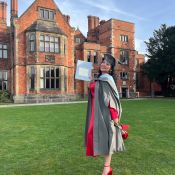





The funding behind my UK dream

Studying in the UK was not an easy decision. In fact, it was a dream that took me more than a decade to turn into a real plan.
At the time, I was living and working in Canada on a temporary permit. When I started rethinking what I wanted for my future, I realised that leaving Mexico had brought me closer to something I had wanted for many years: studying for a master’s degree in Europe.
But having a dream and actually deciding to pursue it are two very different things.
CHOOSING A COUNTRY WAS ONLY THE FIRST STEP
I had to consider the language, the culture, job opportunities, universities, tuition fees, the cost of living, available scholarships and something that was also very important to me: the possibility of building a life in that country after graduation.
My permit in Canada also had an expiry date. I had to decide whether to extend my stay there or use that moment in my life to finally pursue the dream I had postponed for so many years.
The problem was that I had no idea where to start.
I began by messaging friends who had studied somewhere in Europe, and one of them recommended Across the Pond. That recommendation completely changed my application process. Little by little, I realised that the UK met almost everything I was looking for.
Then came the next question: which university should I apply to and, most importantly, how was I going to finance it?
GETTING ACCEPTED WAS ONLY PART OF THE CHALLENGE
With the support of Across the Pond, I worked through the application process step by step and eventually received offers from all three universities I applied to.
However, there were still many challenges to overcome.
Because of the timing of my application, I was no longer able to apply for some of the scholarships I had considered, and my master’s programme was not covered by SECIHTI, formerly CONAHCYT. My university offers were also still conditional because I needed to meet the English language requirement.
That was when FUNED and FIDERH became a fundamental part of my financial plan.
At first, I was nervous about taking out a loan to study. Like many people, I associated debt with starting a new chapter of life under immediate financial pressure.
But I gradually learned to see it differently.
I was not simply borrowing money to pay for a university degree. I was looking for a financial tool that would allow me to invest in my education without having to base every decision during my MBA solely on how much money I had available that month.
MANAGING THE APPLICATIONS WHILE EVERYTHING ELSE WAS HAPPENING
My friends had warned me that funding applications required documents, time, patience and a lot of organisation.
They were right.
What made my experience even more challenging was the personal situation I was dealing with at the same time.
I was living in Canada, working two jobs, studying for my English exam and, at the same time, my father was hospitalised in Mexico with a serious health condition.
Even my choice of university changed during that period. I had originally decided to study at the University of Edinburgh, but my family circumstances made me reconsider what was best for me, and I eventually chose the University of Sheffield.
There were moments when everything felt overwhelming: university applications, paperwork, the English exam, financial decisions and a difficult family situation were all happening at once.
Having guidance throughout the process made an enormous difference.
My experience taught me that you do not need to have absolutely everything figured out from day one. You just need to start, organise each stage and move forward one document and one decision at a time.
THE FUNDING GAVE ME SOMETHING MORE IMPORTANT THAN MONEY
With the support of FUNED and FIDERH, I was able to complement the scholarship I received from the University of Sheffield and have access to funding that helped cover not only my academic commitments, but also the expenses involved in moving to and living in another country.
That was when I realised something I had not fully considered while preparing my budgets in Canada:
Having access to funding also gives you the peace of mind to make better decisions.
Before moving abroad, we calculate almost everything: accommodation, food, transport, university costs and personal expenses. But living in another country always brings unexpected situations.
Knowing that I had financial support allowed me to focus much more on my MBA and experience this stage without the same level of financial pressure that I saw some students around me facing.
Of course, I am very aware that this is money I will need to repay. However, the repayment terms and conditions of these financing options meant that, for me, they became a way of spreading the cost of an important investment over time rather than having to carry the entire financial burden while I was still studying.
Receiving the funds in instalments also helped me manage my money more carefully throughout my postgraduate studies.
MY POSTGRADUATE EXPERIENCE BECAME ABOUT MUCH MORE THAN STUDYING
One of the best pieces of advice someone gave me before I started was:
“Enjoy your year as a student, because time does not come back, and eventually we all return to working life.”
I tried to remember that throughout my MBA.
Having greater financial peace of mind allowed me to enjoy the experience outside the classroom as well.
I travelled to different cities across the UK, met people from many nationalities, joined language exchange groups, tried food from cultures I knew very little about, discovered new hobbies and, for the first time in a long while, gave myself the space to stop and think clearly about what I wanted for my future.
After many years of working, that time also gave me the opportunity to focus on myself again.
That is something I could never have fully appreciated while I was completing applications and calculating budgets from Canada.
AN INVESTMENT THAT MADE MY NEXT CHAPTER POSSIBLE
Living and studying abroad is a significant investment, and applying for financing can be intimidating.
It was for me too.
But today, I see FUNED and FIDERH as tools that helped turn something that had been only a dream for many years into a real experience.
They did more than simply help me pay for a postgraduate degree. They gave me the financial breathing room to focus on learning, adapt to another country, take advantage of the opportunities that appeared along the way and enjoy a stage of my life that I knew would not happen again in quite the same way.
And if I could say something to the version of myself who was in Canada, working, studying English, worried about her family and wondering whether she could really manage all of this, it would be very simple:
Start. You do not need to know how to solve everything from day one.
Thank you to FUNED and FIDERH for helping make this chapter possible, and to Across the Pond for supporting me through a process that, at the beginning, felt far more complicated than I thought I could manage.
In the end, completing my MBA in the UK was not only about fulfilling my dream of studying for a master’s degree in Europe.
It was about proving to myself that the dream I had postponed for so many years could still become a reality.
- Carolina
More than student accommodation

When I started looking for student accommodation in Sheffield, I thought the most important things were simple: price and distance from the university.
I was wrong.
Moving to another country makes you realise that the place you choose to live can influence almost every part of your student experience: how much time you have, how easily you meet people, how comfortable you feel, how much you spend outside your rent, and even how well you cope with stressful university weeks.
For me, finding Vita Student Accommodation in Sheffield turned out to be one of the best decisions I made during my MBA.
THE SHEFFIELD HILLS TAUGHT ME A LESSON
Unlike many international students, I was fortunate enough to stay with friends when I first arrived in Sheffield. This gave me time to explore the city before choosing somewhere to live.
And I quickly discovered something I had definitely not considered while looking at maps from abroad: Sheffield has hills. Lots of them.
A place that looked conveniently close to the university on Google Maps could feel very different when you actually walked there.
That experience changed the way I looked at accommodation. Location was no longer simply about distance. I started thinking about transportation, convenience, safety, facilities and what my everyday routine would actually look like.
That is how I found Vita.
WHAT WAS ACTUALLY INCLUDED?
At first glance, Vita was not the cheapest accommodation option I considered. But I quickly realised that comparing rent alone did not tell the whole story.
During my stay, my accommodation included things that I would otherwise have had to organise and pay for separately: breakfast on weekdays, coffee, a gym, university transportation, room cleaning, social activities and several communal spaces.
There were areas to study and socialise, games, laundry facilities, a cinema room and even a large kitchen that residents could use for gatherings with friends.
My studio was also completely private, with my own bathroom and kitchen.
As an international student adjusting to a new country while doing an intensive postgraduate degree, having everything in one place made my life much easier.
PAYING LESS RENT DOESN'T ALWAYS MEAN SPENDING LESS
This was probably the biggest lesson I learned about choosing student accommodation.
Some of my friends paid less rent than I did, but their everyday experience was very different.
Some regularly paid for public transport or taxis. Others had gym memberships. Some shared kitchens with several flatmates and eventually preferred eating outside because keeping a communal kitchen clean was difficult.
I began to realise that accommodation should not be evaluated only by the number you see on the booking page.
Once I considered transportation, food, the gym, facilities, convenience and—perhaps most importantly—my time, Vita made much more sense financially and practically for me.
Sometimes the cheapest room is not necessarily the option that gives you the best value.
THE EVENTS I NEVER EXPECTED TO NEED
The part of Vita that surprised me most was not my room or the facilities.
It was the events.
There were cooking classes with chefs, fitness sessions with instructors, creative workshops, cocktail-making activities and many other opportunities to try something different.
People attended for different reasons. Some wanted to meet new friends. Some came for the food. Others wanted to exercise or simply have fun.
For me, they became something else.
MBA life can be intense. There were days when I would return home after classes or hours of working on assignments and discover that there was a painting or pottery activity happening downstairs.
Being able to walk into a room, put my laptop away and spend some time making something with my hands gave me a mental break that I did not realise I needed.
That is one of those things that is difficult to put a price on.
FROM A STUDENT BUILDING TO MY HOME
When you move abroad, you leave behind more than your house. You leave your routines, familiar places, family, friends and all those little things that normally make you feel at home.
That is why I believe choosing accommodation as an international student is about much more than finding somewhere to sleep.
You are choosing the place you will return to after a difficult exam, where you will make dinner after a long day, where you may meet some of your first friends and where a significant part of your experience abroad will happen.
Vita started as simply the building where I was going to live while completing my MBA.
Eventually, it became the place where I exercised, studied, relaxed, met people, tried new things and created memories completely unrelated to university.
Somewhere along the way, it stopped feeling like student accommodation.
It became my home in Sheffield.
My advice to anyone choosing accommodation from another country is simple: don't look only at the rent and the distance on a map. Think about the life you want to have once you arrive.
Sometimes where you live becomes one of the most important parts of studying abroad.
- Carolina
Discovering Human-Computer Interaction

Since finishing my degree in Visual Communication, I had always had the idea of pursuing a master’s degree abroad. However, I was not sure what I wanted to study, so I chose to develop my career professionally in Mexico for nine years before making that decision. During that time, I worked in a variety of roles related to traditional graphic design. Although I enjoyed design, I felt that these roles did not allow me to explore other areas that also interested me, particularly technology and business.
I decided to take a UX/UI design bootcamp, which helped me rethink my portfolio and eventually led me to a job at a startup in Mexico City. There, I felt that I had found the area of design in which I wanted to develop my career. I was able to grow within the same company and eventually became the head of the product design team. This experience helped me better understand the kind of work I wanted to specialise in, but it also made me realise how much I still did not know. Towards the end of that same year, the company's situation worsened and several colleagues and I were made redundant. I found myself facing a decision: I could use my redundancy payment as a deposit towards buying a flat and continue with my life as it was, or I could use it to pursue a master’s degree abroad and expand my professional and personal horizons. I chose the latter.
I then began looking for an agency that could help me with the process of studying in London. At first, I was interested in UAL, mainly because of rankings that placed it as the best school in the world for studying design. However, an unforeseen problem with the agency handling my application made me reconsider that option. I started looking for a more technical programme, less focused on the artistic side of design and more on its cognitive and technological aspects. Thanks to the advice of Across the Pond, I discovered the Human-Computer Interaction Design programme at City St George’s, University of London. Originally, I knew very little about the university, but I discovered that the programme had a strong reputation in the UK and was also considerably more affordable than other options I had considered. So far, I have found the course very good and demanding. More importantly, it has answered many of the questions I had about my profession and that originally led me to look for a specialisation.
Another major advantage has been being able to study in London, a city I thought I knew before coming here, but which, after only a short time living in it, made me realise that much of the image I had of it was rooted in the world of Mary Poppins. In reality, not everyone drinks tea, it does not always rain, and certainly not everyone speaks with a posh accent. London has also allowed me to better understand the cultural diversity of Europe. It is a continent with an enormous amount of history, and in the UK, much of that history still shapes the way the country and its society are understood. On top of that, there are the differences between generations, as well as the perspectives brought by tourists and migrants. Experiencing all these different ways of understanding life has probably been one of the most enriching parts of this experience. I would also add all the museums, streets and historic buildings, as well as the cultural heritage that comes from having been such an important country to the rest of the world for centuries.
To be honest, there is nothing I wish I had known before coming that I would now consider essential. Personally — and I know this may be very different for other people — migrating has been much easier than I expected. If I had to mention one thing, I would say that Europeans tend to be more introverted than Latin Americans and that Londoners, in particular, can be very indirect in order to avoid coming across as aggressive. At first, these differences can feel strange, especially when you come from a culture where communication tends to be more expressive and direct, but it is not difficult to get used to. In fact, I think many of them are drawn to the more open and outgoing character that we Latin Americans tend to have. Lately, I have even started seeing quite a few British couples practising salsa in the parks, although without quite the same amount of pulling and mischief that can come with learning to dance it in Latin America… so, for those coming here single, perhaps there is a small opportunity there.
Above all, I can say that this is a culture that is very welcoming to strangers, and where it is remarkably easy to feel safe. Almost everything you think you know about Britain is true and, at the same time, falls short of the reality. There are already far too many songs and poems trying to capture everything this culture has to offer, so perhaps the best thing to do is simply come and experience it for yourself.
- Daniel Andrés
Finding My Place in STEM
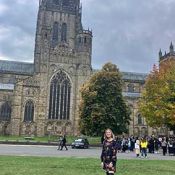
This year in the UK has been an experience I will never forget. Thanks to Across the Pond and the British Council, I applied for and was awarded the Women in STEM Scholarship, giving me the incredible opportunity to move to the UK and pursue my MSc in Biotechnology at Durham University.
Getting here was not as straightforward as it might sound. When I first considered applying for the scholarship, I had a lot of doubts. One of the biggest questions in my head was whether I was “enough” to actually win such a competitive scholarship. I kept wondering whether my experience and academic background were enough to make me a strong candidate.
My assessor at Across the Pond helped me get out of my own head. He told me that I had everything to win and nothing to lose by applying. After that email, I decided to stop questioning myself and submit the application. And I am so glad I did.
The support from Across the Pond was also really helpful throughout the application process. There were quite a few documents and requirements to keep track of, and honestly, I probably would not have known exactly what was needed without their guidance! Their system made it much easier to understand the different steps and organise everything I needed to submit. Having someone there who knew the process and could guide me along the way made the whole experience feel much simpler and more manageable.
Why Durham Became Home
When I first arrived in Durham, I knew I was excited, but I don't think I fully understood everything that this experience would bring.
One of the things I was most excited about was the opportunity to actually live in a Durham college. I stayed at Ustinov College, where I had my own en-suite room throughout the year.
Living in a college was honestly something I had always dreamed about. Growing up, I had seen the idea of university colleges in movies and thought it looked like such a unique experience. So when I finally arrived at Durham and realised that I was actually going to live in one, it felt a little surreal.
There is something very special about being part of a college community at Durham. It gave me a sense of belonging beyond my degree and allowed me to meet people from completely different backgrounds. Having a place where you can come back after a long day at university, see familiar faces and feel part of a community made a huge difference to my experience.
Studying Biotechnology in the UK
A Master's degree is challenging enough, but doing it in another country, adapting to a new academic system, managing everyday life far from home, and trying to make the most of every opportunity has been a whole different experience.
Studying Biotechnology at Durham has pushed me academically and personally. It has required me to become much more independent in the way I approach my studies, manage my time and deal with challenges.
There have definitely been moments when I have felt overwhelmed, homesick, or unsure of myself. But those moments have also taught me that struggling with something doesn't mean you are not capable of doing it.
Sometimes you just need to give yourself time to figure it out.
The International Experience I Didn't Expect
Beyond the academic challenges, one of the things I have valued the most has been the international experience.
Living and studying at Durham has allowed me to meet people from so many different countries, cultures and backgrounds. The campus itself feels like a little international community, where every conversation can teach you something new about the world.
I came to the UK to study Biotechnology, but I have also learned so much simply by being surrounded by people who have completely different experiences from my own.
There is something incredibly valuable about sitting down with someone from another part of the world and realising that, despite having grown up thousands of miles apart, you can still find so much in common.
That international perspective is something I know I will carry with me long after I leave Durham.
Learning Science in Another Language
Another part of the experience that I think is important to mention is studying in English.
English is not my first language, so studying a Master's degree in English has been a challenge of its own. It is one thing to have a conversation in English, and another completely different thing to write an academic paper, understand a complicated scientific concept, participate in discussions and give presentations, all while trying to make sure you are actually saying what you mean and getting your perspective across.
There have been moments when I have had to work twice as hard simply because I was processing both the science and the language at the same time.
But it has also given me a lot of confidence. I have learned that I am capable of communicating and working in an international scientific environment, even when English is not my first language.
More Than Just a Degree
Looking back, I think this year has taught me much more than I expected to learn from a Master's degree.
It has taught me independence, resilience, adaptability and, perhaps most importantly, how much you can grow when you put yourself outside of your comfort zone.
There have been so many moments when I have stopped and thought, “Wow, I am actually doing this.”
I am studying Biotechnology at Durham University, living in the UK, meeting people from all over the world and experiencing a completely different way of life.
And now, when I look at where my career is going, I realise that this experience has changed much more than just my CV.
I truly feel that my career is heading in a direction I would never have fathomed before, and that has been incredibly exciting. I came to the UK to pursue a Master's degree, but I am leaving with a much clearer idea of the kind of scientist I want to become and how I see myself contributing to the scientific world.
Would I Do It Again?
Absolutely. This year has not always been easy, but I know for sure that it has been completely worth it. It has been one of the most rewarding experiences of my life.
I am incredibly grateful to Across the Pond and the British Council for making this opportunity possible, and especially to the people who encouraged me when I was still questioning whether I was “enough” to apply.
Sometimes the biggest obstacle is not whether you are capable, but convincing yourself to take the chance.
And now I am here, finishing my Master's in Biotechnology at Durham University, with a year of knowledge, memories, friendships, challenges and experiences that I will carry with me for life.
This experience has already shaped the person I am and the way I see my future in science. And I cannot wait to see where it takes me next.
- Wendy
How My Master's Changed My Career

Why I chose the University of York
When I was researching Master's programmes, I wanted something that combined theory with practical clinical knowledge. The MSc in Development and Clinical Practice at the University of York stood out immediately because of its focus on child neurodevelopment, developmental conditions and evidence-based interventions.
During the admissions process, I also noticed something that became one of my favourite things about York: the people. Even before I accepted my offer, everyone I spoke to was approachable, supportive and genuinely interested in helping prospective students.
That support ever disappeared once I became a student.
Learning beyond the textbooks
One of the most fascinating aspects of my degree was comparing how developmental assessments and support services are delivered in the UK versus Mexico.
Learning about Child and Adolescent Mental Health Services (CAMHS) and the wider support system completely changed how I think about multidisciplinary care and long-term intervention for children and families.
The course constantly encouraged us to think critically, compare international approaches and consider how different healthcare systems can learn from one another.
The people who made the difference
My supervisor deserves a special mention: having someone who was knowledgeable, encouraging and always willing to discuss ideas made a huge difference to my confidence throughout the programme.
The wider university staff were equally supportive, and I always felt comfortable asking for help whenever I needed it.
Using my degree every single day
One of the best parts about this Master's is that I still use what I learned every day. I now work in the UK supporting students with autism and other mental health needs. The knowledge I gained at York helps me make appropriate adjustments, better understand individual needs and approach each case with greater confidence. In the future, I hope to return to Mexico and establish my own private practice supporting children and their families.
Knowing that the education I received in York will continue making a difference long after graduation is probably the greatest outcome I could have hoped for. For me, this Master's wasn't simply another qualification, it became the foundation for the career I want to build.
-Denisse