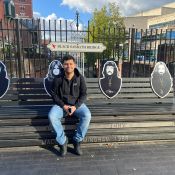





I still remember starting my final year of high school with no clear idea or thoughts about what would come next. Counsellors and teachers had talked about study choices and the application process, but studying abroad was never a topic that came up. Studying abroad appealed to me, but I needed to figure out how to make it happen. The thought of being far away from friends and family was daunting and overwhelming. I also knew studying abroad was expensive compared to Norway, which caused some concern. After a year as a law student at the Royal Holloway University of London, I wish to go back in time and tell myself that there is nothing to worry about and everything will be okay.
The main reason I chose to study abroad was that I envisioned a career in international human rights law, and I believed that a law degree in England, compared to Norway, could open more doors for this path, even though it meant I probably wouldn’t end up practising law in Norway. When I got in touch with Across the Pond, I explained my career aspirations and my advisor presented various programs that could appeal to schools across the UK. That’s when I discovered LLB Law with International Relations at RHUL. I got a bachelor’s degree in law, which you need to qualify as a solicitor or barrister in England, and another degree in International Relations, which discusses war, economy, politics, and how the global society is structured from different perspectives.
Royal Holloway University of London is an idyllic university in a small town southwest of London called Egham. The famous old building called Founders was established in 1879 by the Victorian philanthropist Thomas Holloway, and the school was officially opened in 1886 by Queen Victoria as an all-woman’s college to give women the opportunity for higher education. Today, you can see statues of Queen Victoria, Thomas Holloway, and his wife on campus. Founders has also been used to film several movies and series, such as Avengers, YOU, and Downtown Abbey. I enjoyed living on campus during my first year of studies and understood what this school offers. Everything from parties and nightclubs to two school libraries, restaurants/cafés, a grocery store, and a fitness centre. All of this has made life at RHUL much easier and more attractive. Not to mention RHUL gardens, the school is surrounded by beautiful nature and parks that give you a natural feel of the English countryside. Egham is a small town with enough to offer, but London is just 40 minutes away by train if you want more excitement. I appreciate living in the countryside; I prefer a peaceful and beautiful environment alongside my studies, and I’ve travelled to London several times when the mood struck. The school offers many clubs, volunteer programs, and sports, which are great ways to fill the week when you’re not studying. A friend and I became leaders of an environmental volunteer program; we organised various activities so our fellow students could sign up and support causes they care about. Extracurricular work can be gratifying to have on your CV!
Student life as an international student has its pros and cons. I have found an excellent social circle at school with friends from all over the world. As an international student, I gravitate towards other international students since we’re in the same boat. We relate to what it’s like to move to another country and adjust to the customs and culture of that country. Now, Norway isn’t very different from England. I didn’t experience a big culture shock compared to others I met from Singapore or Argentina, where the cultural differences are more significant. I felt that my first weeks in England went by quickly because there was so much new to adjust to; I noticed that I didn’t have time to get homesick, and it took a long time before I thought about Norway. I feel fortunate that I adapted to the English lifestyle quite quickly and noticed that apart from family, what I missed from Norway was nature, the language, and milk chocolate since the one in England is not worth mentioning. However, these were just minor issues, and as time passed, I became more comfortable and happy living in England.
One practical advantage of living in England is that groceries are cheaper than in Norway. Even though the Norwegian krone is weak, I get much more for my money than I would in Norway. The school offers all textbooks digitally, so I don’t buy books; I read on an iPad and use a computer to write texts, etc. My most significant expenses are tuition fees and accommodation, covered by the Norwegian State Educational Loan Fund (Lånekassen). I lived on campus during my first year, where there were three payments throughout the school year. I had my room and bathroom and shared a kitchen with seven others. If you are interested in studying at RHUL, in that case, I recommend staying in Tuke, Williamson, Butler, Gower Wedderburn, or George Elliot, as these accommodations are the newest and give you the most value for your money. Many new students choose to live in Founders, and although it’s very picturesque since it looks like something out of Harry Potter, you have to share a bathroom. It’s also catered, so you don’t have the resources to cook your food, and the meals offered must be paid for in addition to the accommodation fee.
I loved living on campus; it’s much cheaper than living in the surrounding area, and all school facilities are within a short walking distance, but unfortunately, you’re only guaranteed a place on campus in your first year. I’ve been lucky enough to get a job in a school service department that helps new students with everything related to living on campus and well-being. Through this job, I still live on campus with my colleagues and students at the school. This job opportunity is open to all students every year; the school also offers many other jobs, which are a great way to earn extra money alongside your studies without travelling far for work. This can include working in the school’s help departments, in cafés, bars, restaurants, grocery stores, or fitness centres.
As a law student, I have lectures 5-6 times a week and seminars four times a week. Seminars are mandatory, while lectures are optional, but I recommend attending. Since you get a bigger picture of the content, and if you feel that the reading material has been complex, attending the lectures can bring clarity. I am delighted with my education; studying law is interesting, although some reading material can dry. Therefore, I appreciate my International Relations degree, which gives me a little break from the law and opens up the possibility for more creative and analytical thinking
The most complicated part of moving to England is the visa and application process, but here, I got excellent help from my advisor at Across the Pond. Looking back, I wish I knew how long the application process could take when you want to study law in England. I didn’t realise until December of my last year of high school that I wanted to study abroad. So, there were many schools I was interested in applying to that I didn’t get the opportunity to apply to because they had deadlines in October. Many schools also require that you take various knowledge tests related to law in good time and then send the result as part of the application process. Had I done research in a reasonable time before, I would have had the opportunity to explore other schools and options. Compared to Norway, the schools don’t just look at your grades at the end of high school, but you also have to write an essay explaining why you want to get into this program. This is an advantage if you don’t have sufficiently high grades since a gym grade shouldn’t ruin your chances of studying, for example, medicine. I also got good guidance from Across the Pond; my advisor gave me tips on improving the essay and what I might consider dropping or including.
England has become my second home. I miss Norway and often relate to the saying, ‘There’s no place like home’, but I can honestly say that after long periods at home, I miss the life I’ve built in England. And after a year, I feel the saying can go both ways. Across the Pond was an essential resource during the application process, and I wouldn’t have been able to fulfil my dream of studying abroad without them. After I explained what I wanted, they found programs and schools that might suit me and sent my applications. They contacted the schools for me when needed and made the entire application process less complicated than it first seemed. So, if you're going to study in England, I would use Across the Pond!
I hope my experiences will be helpful to those of you considering studying Across the Pond. My first year as a student in England has been both challenging and rewarding. Despite concerns about being far from family, costs, and culture shock, I’ve found that many of these fears were unfounded. I feel that I have grown both academically and personally, made friends from all over the world, and now have a broader understanding of law and International Relations. Studying at the Royal Holloway University of London has given me a solid foundation for a future career while also providing unforgettable experiences. Without the help from Across the Pond, I might not have been able to take the step. If you’re considering studying abroad, my advice is to go for it—the challenges you face will be outweighed by the many opportunities and experiences you’ll gain.
- Serena
I was feeling stuck in Monterrey, working from home at a global company, and I knew I needed a change. I wanted something new and exciting that would help me grow both in my studies and as a person. That's when I decided to look for a Master's program in the UK. Since I already spoke English, the UK felt like the best option—plus, I'm a huge football fan, and the idea of being surrounded by that culture was thrilling.
But moving to another continent wasn’t easy. I was scared to leave my home and be so far from my family. The thought of starting fresh in a new country was both exciting and nerve-wracking.
When I finally got to the UK, things didn’t go exactly as I expected. I thought I’d be learning all about British culture and meeting lots of British people, but that didn’t really happen. It turns out, British students don’t usually do Masters in Business. Instead, I found myself surrounded by people from all over the world, especially from Asian countries like China, India, Thailand, and Indonesia. There were only a few British students in my course, but meeting so many people from different cultures turned out to be an amazing experience I never saw coming.
Choosing Newcastle University was a clear decision for me. The university offered the best program in Digital Business, aligning perfectly with my academic goals. Being part of the Russell Group, known for its prestigious research and teaching, added to its appeal. Plus, Newcastle is celebrated as one of the best student cities in the UK, offering an affordable and vibrant lifestyle.
The Faculty of Business was a highlight of my experience. It was conveniently located just in front of St James' Park, the home of Newcastle United—an exciting daily view for a football fan like me! The proximity to the city centre made it easy to explore, and the metro station right outside the faculty simplified getting around.
Overall, my time at Newcastle University was fantastic. The classes were engaging, the people were welcoming, and the city life was both easy and enjoyable. It was a perfect fit for both my academic and personal growth.
For my time at Newcastle University, I stayed in a university dorm in South Gosforth, one of the more upscale areas of the city. My dorm was just a 5-minute walk from the South Gosforth metro station, making it incredibly convenient to reach the university and the city centre in about 8 minutes.
Overall, my accommodation had its ups and downs. On the positive side, my flat was comfortable with a spacious room and a great common area for socializing. The neighbourhood had a dedicated social space for students, which was perfect for meeting new people. Plus, the dorm was more affordable compared to other options provided by the university.
However, living in South Gosforth did have some drawbacks. Although it was only a short metro ride from the city centre, the distance sometimes made socializing a bit tricky. Many friends lived closer to the city centre, and since the metro closed early, I often had to take an Uber home, which could get pricey.
I also faced a few challenges with the accommodation. The internet connection was unreliable, and there was a period when the hot water in the shower wasn’t working, though it was eventually fixed. Sharing the flat with five other people meant that keeping the kitchen and common areas clean was sometimes a struggle.
One of the most striking differences between student life in the UK and Mexico was the incredible diversity. Back home, I was accustomed to studying and working primarily with Mexican people. In the UK, I found myself surrounded by students from various countries and cultures, which was both exciting and enriching.
Living with people from different backgrounds was a unique experience. We all managed to adapt well and learned a great deal from each other, broadening our perspectives in the process. Despite these cultural differences, the ability to connect and collaborate with such a diverse group was truly rewarding.
In terms of lifestyle, I aimed to maintain a similar routine to what I had in Mexico, and I found it quite achievable. The day-to-day activities and social norms were more familiar than I expected, allowing for a smooth transition.
Overall, the opportunity to meet new people and immerse myself in different cultures made my time in the UK incredibly fulfilling. It was the diversity and the interactions with individuals from around the world that truly made the experience special.
For my Master’s, I pursued a degree in Digital Business. This program offered a deep dive into how various facets of a company operate in the digital age. We explored everything from data analytics and marketing to logistics, supply chain management, information systems, and project management—each through a digital lens.
I chose this course because I wanted to be ahead of the curve as digitization continues to advance in Mexico. Being prepared for these changes felt crucial to me. The course turned out to be a perfect fit. I thoroughly enjoyed every class and found each module incredibly relevant to my goals. One of the highlights for me was gaining a thorough understanding of a company’s lifecycle and its different departments, all viewed through the digital perspective.
Now, I feel more equipped to navigate the digital transformation that's coming to Mexico, making me more confident and prepared for the future.
Newcastle upon Tyne quickly became a favourite of mine. It’s a charming and peaceful city that’s perfect for walking and running—something I couldn’t do back in the hot climate of Monterrey. The weather, though windy and cold, made for refreshing strolls and jogs. The locals, affectionately known as Geordies, are incredibly friendly and welcoming.
The city centre is a gem, boasting a beautiful mix of beach, parks, and historical sites like castles. Plus, it’s conveniently close to other picturesque towns such as Durham, Northumberland, and York, and even Edinburgh is within reach.
What I loved most about Newcastle was its vibrant atmosphere. The streets were always lively with people enjoying their time out. The cost of living was reasonable, and there was no shortage of places to eat, socialize, and have fun. The nightlife was fantastic, with numerous pubs and clubs to explore, all in a safe environment where you could walk around even late at night without worry.
I had a blast engaging in various activities—attending Newcastle United football matches, dining at local restaurants, running in different parks, shopping in various centres (including Costco), and hitting up clubs with friends. I also enjoyed visiting landmarks like the castle and exploring the quayside with its local markets.
The cultural vibe in Newcastle is quite different from Monterrey, offering a refreshing change and adding to the richness of my experience.
British accents presented a unique challenge, especially the Geordie accent in Newcastle, which was tough even for other Brits. However, engaging with locals helped me adapt and improve my understanding.
My English skills were strong before moving, thanks to my work in a global company. Learning British English boosted my confidence. For future students, practicing British English by watching British TV shows and movies can be very helpful.
My journey to studying in the UK was made incredibly smooth and successful thanks to Across the Pond. Their support throughout the application process was exceptional. From start to finish, my agent was there to guide me, making sure everything went smoothly and helping me apply to Newcastle University with ease.
Without their help, I doubt I would have been able to navigate the process as effectively. Their expertise and assistance were invaluable in making my study abroad dreams a reality.
I highly recommend Across the Pond to any future students looking to study abroad. Their dedicated support and thorough guidance were key to my successful application and transition.
- Victor
As a professional in Electronic Engineering in Mexico with five years of experience working in various jobs and engineering fields, I realized that simply having a university degree was not enough to get the job I wanted or to start my own business, as I aspire to do. I lacked the knowledge or adequate experience provided by the companies that had hired me, so I decided to pursue a Master's in Renewable Energy.
Studying in Mexico was no longer an option for my growth and the path I wanted to take, so I chose to study in the United Kingdom because of the opportunities that open up when you have a Master's degree from the UK, as these are international opportunities. For example, even before finishing the program, I have already received job offers via LinkedIn for positions in the UK and even from other European countries like Poland or Germany.
I chose the UK because of the language, as English is an internationally required language. Personally, I have been learning English since I was very young, so it was easy for me to adapt, but even if you're not perfectly fluent, living here helps you acquire the ability to communicate with everyone. You should also consider that in the UK, there are people from all over the world, and everyone has different native languages, so you don't have to speak it perfectly to communicate well.
This university is located in the north of London, in a very accessible area close to major tourist and social attractions. In general, it’s a school that provides support in all the areas you need. The only thing I would recommend is to frequently ask questions and visit your program director, as they may sometimes forget about you or your situation if a problem arises. When you have a concern, insist on asking about all your doubts, and they will gladly respond within approximately 24 hours, as long as you insist.
The program I chose, MSc. Renewable Energy and Power Systems Management, focuses on the correct management of generation and demand, along with the electrical system, technical and financial aspects, and the regulations of the electricity market in the UK and Europe. This provides you with international opportunities. The program mainly covers areas such as Power Electronics, the Electricity Market, Smart Grid, Electrical Distribution, Wind Energy Generation, Solar Energy, Demand Optimization, among others.
The course is divided into eight modules, for which you have to take an exam that accounts for 50% of the grade and a written/practical project that accounts for the other 50%. After finishing and passing all the modules, you choose a project for your thesis, on which you will work for three months.
Staying in London is a bit more expensive compared to other cities in England. I considered living in London in the school’s student accommodations, but I also looked for options in the counties near London where there is direct access to the city. I found a room in a city 25 minutes by train from London on the UK website ‘SpareRoom,’ where you can interact directly with the people who are renting. You can search for options there and do video calls with potential landlords to find rooms that meet your needs.
I currently live in St. Albans City, a town 25 minutes by train from London. It’s a very beautiful, well-preserved, and quiet city that makes you feel at home. I can visit London whenever I want without having to live directly there, as it has a direct connection to King Cross in North London. It’s a peaceful city where you can find pubs, cafes, shops, supermarkets, etc., without needing to live in London, and the rent is more affordable.
For each module’s projects, I recommend working on them early, as soon as you know what you need to do. They may seem easy, but they are not, as each project requires research time. In the UK, they usually encourage you to research the topic on your own, and this can take time, so a well-organized agenda will always help you succeed. Social life happens naturally when you’re at ease, knowing that you have your tasks well organized. I don't recommend starting everything the last week, as you won’t have enough time to complete it.
My classmates are mainly from Asian countries. You spend most of your time with them, so they inevitably become your friends. If you want to meet different people or those aligned with your interests, it’s recommended to make friends through social media groups or events that you wish to attend based on your interests. That’s mainly where you can find people with whom you have things in common, and from different nationalities.
Financial:
It is very important to consider the costs and have an initial balance for essentials like food, rent, and transportation. Transportation is usually expensive, so if you plan to live far from the university, you must consider this significant expense. Stick to your budget as much as possible if it’s tight.
Transportation:
In the UK, transportation is quite expensive, and there are many train service strikes, so it’s crucial to consider this expense and the time it will take you to travel from your accommodation to the university if you plan to live far from it. This is a very important aspect because your mobility to classes or important events depends on it.
Grades:
In UK schools, grading scales are different. The minimum passing grade is 50/100, but lecturers grade more strictly than in Mexico, so a very good grade is 70. Don’t be alarmed if you pass a subject with 50-60, as this is average in the UK. For the modules, each has credits that you need to accumulate to obtain the degree; these credits are earned by passing the module, so the scale of the grade itself is not that important.
Across The Pond helped me a lot with the selection and application to the university. For the initial documents required to apply, they provide advice on how to improve your Personal Statement so that the university approves it. They also support you by sending available scholarships to help you as much as possible in achieving your personal goal.
They also assist by informing you about financial institutions that can support you, like FIDERH and FUNED. Without my advisor from Across the Pond, I wouldn’t have known about several opportunities available, like scholarships before starting the course. He also helped me with some doubts I had about the school even after the process.
- Stefanie
Studying abroad was always my “one day” dream and being able to do it, is something I will always keep in my heart.
I chose to study in the UK because I have always been fascinated by its history and culture. Also, the official language of the UK is English, and I wanted to have the opportunity to challenge myself to study in another language.
After applying to several universities, I decided to study at Queen's University of Belfast, the MSc Leadership for Sustainable Development programme. I chose this university because of its prestige, as it has a good ranking and is part of the Russell Group. I also liked that the university is committed to being net zero emissions and is part of the United Nations agreement where they recognize its key role in education to achieve the sustainable development goals. On the other hand, my programme includes 3 placements, which are an excellent way to gain international work experience.
The city of Belfast is located in Northern Ireland, and although it is very small, it is full of students and young people, which gives a lot of life to the city, as well as entertainment options of all kinds; nightlife, cafes, restaurants, artistic activities, etc. The people are very friendly and warm.
I had the opportunity to live in the university residences in the city centre, and I highly recommend it, since my building is full of international students who, like me, wanted to make friends, share their culture and have a great experience. You will always find friendly people around you to make friends with.
What I value the most from this experience is everything I learned and grew this year, both academically and personally. Academically, I learned a lot and developed many technical skills in my area of interest, especially with the placements I did. Personally, it's incredible to realize how much I've grown this year.
Sometimes, daring to go to another country to study, especially one so far from home and that doesn't speak your language, can be very intimidating, but the most challenging situations also teach us everything we are capable of achieving. I am very grateful to Across the Pond for guiding me throughout the application process, from the beginning when I was totally lost on what to do, until the moment when I was accepted by the university and managed to get funding for my master's degree.
- Sandra
Hello! My name is Maria, I am from Sibajahui, El Fuerte, Sinaloa; a small rural town with around 600 inhabitants. For people like me, living in areas without access to additional services like foreign language education, studying abroad seemed like a distant dream. Fortunately, I found a way to prepare and learn the language, and while browsing online, I discovered Across the Pond agency, which was a godsend on this journey.
Their guidance throughout the process was incredibly helpful and allowed me to understand step-by-step what I needed to do to apply to universities, as there was too much information to process initially. They also provided guidance on applying for the Chevening scholarship.Thanks to their support, I'm now writing this from the UK, about to finish my Master's in Sustainable Energy Engineering at the University of Nottingham.
I chose this course and university because of its technical focus, which was what I was looking for, and the modules are relevant to current energy issues, such as green hydrogen.
With 300 acres of grounds, the campus is one of England's most beautiful university campuses. Hidden within the grounds are enchanting gardens that help you relax and connect with nature. The university is also home to Highfields Park, where you can boat on the lake and enjoy spectacular views of the Trent Building (the university's iconic building).
Student life is excellent, with many societies and clubs to join... from sports clubs (I joined archery and discovered I'm good at it!) to travel societies (organizing affordable trips every weekend). The university prioritizes students' mental health and offers many services.
You've heard of Robin Hood? Well, let me tell you that the story is set here in Nottingham, in Sherwood Forest. The public transportation services are excellent and punctual, and at Christmas, there's a lovely Christmas market that makes you feel like you're in Santa's Village at the North Pole. If you're into partying, Nottingham offers a nightlife that never ends, with great parties and guaranteed fun, and a wide range of dance clubs and pubs. Did you know that the oldest pub in England is here?
My favorite spot in Nottingham is Wollaton Park, where Batman: The Dark Knight Rises was filmed, featuring the stunning Wayne Manor.
Before coming to the UK, I was anxious to meet my flatmates. My dream was always to share a kitchen to make friends and food. I'm thrilled to have found what I was looking for at Student Roost - Nottingham Two. I have my own room and bathroom, which I find charming and private, and share the kitchen with three others. During this year, I became great friends with my flatmates, and in that kitchen, we've created unforgettable memories. The accommodation also has a study room, ideal for when you have a lot of work.
Overall, I've had a wonderful year. I highly recommend coming to the UK to study for a postgraduate degree, as academic excellence, history, iconic landmarks, and the culture of a good cup of tea come together to give you the warmest welcome to the best year of your life.
- Maria
The United Kingdom offers something academically that I couldn't find in other countries: a wide range of master's programs in interdisciplinary studies. For a long time, I was interested in Environmental Humanities (the intersection between Humanities and Environmental Studies), specifically in ecocriticism (the study of nature in literature), but in Mexico, where I’m from, there isn't a university that specializes in this field. Additionally, I wanted a master’s program that would provide practical tools for the job market, not just theory. I found these specific requirements in the MSc in Environment, Culture, and Society at the University of Edinburgh, a comprehensive program with courses in art and environment, political ecology, and environmental philosophy. We also had field trips and meetings with artists that beautifully complemented the theoretical classes.
What I appreciated most about studying there is that the programs generally have a multidimensional perspective. Environmental problems and solutions, for example, aren’t just technical issues, but also human and social ones.
Although I knew that similar programs existed in the United States, I chose the United Kingdom for the lifestyle, and that's what I want to talk about.
During my university years in Mexico, I spent three hours a day in traffic getting to and from school. In Edinburgh, on the other hand, it took me just 25 minutes to walk from my house to campus, and 15 minutes by bike. This small but significant change in my life allowed me to do so much more: join student associations, have a better social life, have more time to eat well and exercise, and I even managed to keep a part-time job!
I was also lucky that my house and the library were very close to one of Edinburgh's large parks, so if I felt stressed, sometimes just a 15-minute walk would help me reset before getting back to studying.
The transportation system here is very efficient and offers many options, which made it easy to make plans with friends because I knew I could get anywhere easily. Also, being close to the train station meant that if I wanted to visit a small town like Stirling or Perth on the weekend, or take a short hike in Linlithgow, I could get there with ease.
If there was one thing the various University of Edinburgh campuses had in abundance, it was study spaces. Whether on couches, tables, in libraries, study buildings, or cafes, you could find a spot to study before, after, or between classes. In my school, we also had something called the Hub, where you could access with your student ID. Inside, besides computers and study spaces, there was a small kitchen where students could store and heat their food, prepare tea or coffee, and then wash their dishes. There was something similar in a building dedicated to study spaces, which also had a microwave, hot water, and tables for eating. This made my life easier because on days when I didn't have classes, I would bring my lunch and spend the whole day studying, writing essays, and taking breaks to eat and make myself coffee before heading home.
Every now and then, I would change my study spot to explore other campuses or simply to take different routes through the city. For example, sometimes I would go to the Architecture, Art, and Design library because I liked passing through the Old Town. Sometimes, before or after studying, I’d take a walk there and enjoy the views.
The University of Edinburgh has a Disability & Learning Support Service that you can turn to if you have learning difficulties. There are special booths in the library, and there are also wellbeing services if you're struggling. This allowed me, for example, when I had mental and physical health issues, to ask for help and receive support in my studies. Without a doubt, this enabled me to have better academic and personal development.
I was fortunate to "inherit" the apartment of a girl who had the same scholarship as me (Chevening). So I recommend contacting scholarship holders or students to ask if they know of any accommodation. Maybe they’re about to leave theirs!
I preferred to stay in a private apartment for reasons of privacy, cleanliness, and having the opportunity to host friends or family. Also, since I decided to stay for more than a year, it was quite convenient. Friends who stayed in student accommodation had to move out once their contract year ended, but I was able to extend mine.
Whether you stay in student accommodation or a private apartment, I recommend choosing one close to your campus. Make sure to check where your classes will be.
At first, I was very nervous about speaking because my pronunciation isn’t the best, and neither is my level of English, but in Scotland, people are very patient. Try to listen carefully and ask if you don't understand a phrase or word. The Scots will certainly try to make themselves understood. Also, since Edinburgh is such a multicultural city, you’re sure to find people from all over the world, even some who speak your language.
In Edinburgh, they say that if you don’t like the weather, just wait 15 minutes. That’s how changeable it is. It can start sunny, then rain, then have strong winds, and then end with a beautiful sunset all in one day. So never take anything for granted and always carry your raincoat. I don’t recommend buying an umbrella because they break in the wind, but a good raincoat and maybe some boots will make your life much easier. Always check the wind conditions because it can be sunny and at a nice temperature, but if it’s windy, you’ll feel cold. In the summer, make the most of the sunny days by organizing picnics in The Meadows or Holyrood Park or hikes with your classmates or friends.
Also, prepare for winter because it gets dark at 3:30 pm, and the sun doesn’t rise until 9 am. It may seem terrible, but I learned to enjoy it by lighting scented candles (not recommended if you’re in student accommodation because the fire alarm will go off), burning incense, and drinking lots of hot chocolate with marshmallows and mulled wine. That said, try to keep going out and making plans with your friends, even if it’s raining and windy. That will help you maintain a balanced mental state. On the other hand, in the summer, the roles are reversed, so you’ll have very long days and can watch sunsets at 11 pm.
It seemed impossible to receive personalized advice and constant help without being charged for it, and I’ve seen that many people worry that the help offered by Across the Pond isn’t real, but I can assure you that everything is legitimate.
My advisor helped me from start to finish while I was also applying for the scholarship. Their extensive experience made many processes easier, gave me very valuable tips before, during, and after the application, and even helped me make better decisions.
Thank you so much for your invaluable help and for answering all my questions!
- Karla
Coming to study in the United Kingdom has been one of the best experiences that have happened to me in my life and has changed the way I see the world.
At first, I was a little nervous and wondering what could happen, because a challenge like this is not easy, you leave your family, friends and partner to make a dream come true, a dream that many would like to realize but not all. They are given the opportunity. You arrive in a new country with a new culture, with another language, which is not the one you are used to and at first you don't know what to expect but you are sure that this will change your life.
I finished studying my master's degree at the University of York, one of the most beautiful universities in the entire UK. The university is one of the best in terms of technology.
York is one of the most beautiful cities I have ever seen, very quiet and its people made me feel at home, everyone helps you if you need something or want to know something; It is a city that has a lot of history and I love that, from the Vikings and different places to visit, although it is a small city, you can get to know too many things.
Here I met friends who became very important to me, who had the same fear and concerns as me, who wanted to take on the world by getting to know other cultures or simply living with more people. I met many Latinos who made me feel unique and that Latino community that was created was very special because we were always there for what we needed; we did not leave anyone without help. People from other cultures who are not Latino were very kind and we had incredible moments together, moments that there is no exact definition; different parties we went to, different moments of laughing, crying, being angry because our plans didn't turn out as we thought but it was worth it, that's part of living, it's part of learning in life, always moving forward despite the adversities.
We all agree with the same thing; That is, that present fear that cannot be removed, that fear that is unique but as they say, “it is better to try than just think: What would have happened?”, those phrases define a lot, being outside your social circle increases your shape too much. to see the world and further forges your identity, it helps you understand who you are and what opportunities you have to take to be a better person.
When you finish your studies, you really are another person, you are a unique person, a very different person from the one who arrived, a person who not only made friends, but also made brothers for life. Moments that no one will change and many moments that will live in your head. If I could go back in time, I would tell myself “Try it without fear, you will see how much you can do it and how much you have learned, you are strong for this challenge that is coming, it will change your life but for the better and you will meet people you want to keep their friendship.”
The personal advice I can give you is to try, not to stay on the path, which I know is scary, uncertain about what will happen but I know that you will be better people; You will meet excellent people, people who will be unforgettable and even though they are far away, they are with you through a message, I know that it can be done and that is how it should be.
- Mario
Deciding to study abroad has been one of the best decisions that I've made. All of which will be mentioned in the following text, but mainly because I felt that I needed a change, an adventure, to have a break and to figure it out where I wanted to go next, personally and professionally, and there wasn’t a better way to do this than to do a masters degree in a topic that I feel very passionate about, with the perks of giving me additional credibility in the industry that i'm interested in keep exploring, and of course expanding my knowledge and experience.
I studied a Master’s degree in Cultural and Creative Industries at the University of Sussex, located in Brighton, England. Brighton is a very special city in the UK, and everyone who has lived there or visited can agree with me. First and foremost, since it's a university city, there is so much going on and life around the city, things to do, events every month, it is right by the beach which, in the summer is the best activity to do. Being there with your friends until the sun goes down. Also, central London is only 1 hour away from Brighton Station which gave me access to a bunch of events, nights out and exploring one of the most alive cities in the world.
Sussex is one of the top universities in the UK and I was so excited to learn, but the international exposure that I experienced definitely was one of the most enriching experiences that I could have had expected beyond any academic knowledge.
I made good friends from all around the world, and they are so special to me today because we got to experience a whole new “life” together which created a stronger bond between us. Each of us saw this year with its own personal lense, and I got to change the way I perceive the world and myself thanks to this. There is normal life, and there is student life, that’s all that i'm going to say and once you experience this, you’ll know exactly what this is.
I came across, Across the Pond, through a facebook group. Some people were asking for guidance to study abroad, so I clicked the link and started out my process. My advisor helped me through every single step of the way from questions, to applications, to proofread my essays.
Hope my testimony will motivate you to go, you wont regret.
- Mariajose
Hello, my name is Paula. I'm Mexican, and in September, I moved to Aberdeen, Scotland, to pursue my MSc Digital Marketing at RGU. This process took me over two years to finalise, as I kept postponing it because I knew I would miss my family, friends, and the comfort of home. Perhaps, deep down, I was afraid I wouldn’t succeed, but I couldn’t be more grateful for having made this decision. I now understand that it happened at the right time, and I never imagined that in the process, I would meet the right person to share this experience with—my husband, Gerardo.
Since my first contact with the agency Across the Pond, my advisor was always attentive and understanding of my process. And when I decided to take the next step, the agency was always there, offering her support and motivation through advice and guidance for each of the steps I needed to take. Thank you for everything!
A month before this adventure began, my life took a 360° turn—I married the love of my life! Of course, we had many doubts at first about how the long-distance relationship would work, but I can tell you that, although it’s not easy, it is possible. We were very fortunate to be able to move to Aberdeen, a city that has been very generous and has allowed us to grow, enjoy, appreciate, and value each of the experiences we’ve gone through.
Robert Gordon University makes you feel welcome from day one. All the activities and events they organize during the first weeks of classes help you meet many people and find the club/society that you like. In my case, I joined dance, swimming, and the Latin American society. I also met the Mexican society at the University of Aberdeen, and it’s nice to feel a bit of home in a new country.
Regarding classes, I was surprised by how flexible my schedule was. I mostly had 3 to 4 subjects per semester and attended classes 2 to 3 hours a day with at least one weekday off. This is very different from my home country, but it’s something I appreciated because it allowed us to explore the city, travel, engage in other activities, or work. Additionally, the classes connect you with the industry by working directly with live clients who come to the classroom to talk about their companies, and they allow us to propose strategies and campaigns for them. This was great for me because it was my first time experiencing this area. Overall, the campus is large and offers many facilities that make student life more comfortable, stress-free, and easily accessible, such as the library, gym with a pool, or the cafeterias (there’s a Starbucks). However, it’s important to develop the ability to be self-taught. All the professors are very kind and available via email or in class, and the topics they cover are precise and with plenty of material for us to learn more, but it is necessary to be organized and committed.
I lived for four months in a school residence, which was a great experience sharing with six other people. The villa was lovely and a 30-minute walk from the school. The best part was that I had my own bathroom in my room. Perhaps something I didn’t quite get used to was adapting to the different ideas of cleanliness that each of us had, but overall, everything went well. Then, my husband arrived in Aberdeen, and we moved into an apartment by ourselves, which is also a good option if you prefer to have your own space. The only downside is that the electricity and gas bills can be high in winter, but good organization can solve that.
Lastly, as I mentioned, it’s easy to combine work and studies, and although the job search process can be slow, you will find something. In my case, I’ve worked as a receptionist, nanny, accountant (remotely), but the best part was finding a job that allowed me to give back a little of what RGU gave me—I’m a Student Ambassador, and it has been an experience that has taught me a lot.
Aberdeen has it all. It’s perfect for students, couples, and entire families. It has beaches, mountains, parks, museums, international restaurants, and much more. It’s located in the northeast of Scotland, three hours from Edinburgh and Glasgow. It’s actually very easy and even economical to travel between these three main destinations in Scotland and around. My favourite part of Aberdeen is undoubtedly the beach. It has a boardwalk where you can walk, grab a snack from food trucks, visit the mini amusement park, dine at delicious restaurants, go to the cinema, shop, or even see the Northern Lights.
Scottish people are very friendly. They always try to talk to you, see how you’re doing, or ask if they can help with anything. The weather in the city depends on the time of year, but what’s always present is a bit of wind and rain. In December, there’s snow, and it’s fascinating to see it fall and wake up the next day to streets covered in white. The sunlight is something very drastic here. In autumn-winter, the sun can set as early as 3:30 pm and rise around 8:00 am, but in spring-summer, night almost doesn’t exist. There can be light from 4:00 am until 11:00 pm, and well, it depends on each person’s preference, but what I love most about the weather is that you get to enjoy both the cold and warmth without it going to extremes.
For me, this adventure felt like starting over in many aspects of my life. I feel it has been an opportunity to grow both professionally and personally, with some challenges but also with many unique and special moments, and above all, with new dreams that I can share with the people I love.
Today, I can say that it has all been worth it. Thank you!
- Paula
After graduating from university, I spent a few years working in the industry, but I still wanted to pursue a master's degree, mainly focused on research. After investigating various options and evaluating my possibilities, with the help of my Across the Pond advisor, I enrolled at Queen Mary University of London.
At the time of writing this essay, a year has passed since I started studying in London, to the point where I'm about to finish the program. I can summarise that my experience has exceeded my expectations in several ways, which I will try to outline in the following paragraphs.
In the academic area, the experience completely surpassed my expectations and led me to push myself to the maximum. I feel as if there's a before and after in terms of the knowledge I've acquired, and I know it will help me get a job in my master's field or, if I decide to, continue with a Ph.D. Contrary to other experiences I've heard about, I can't say it's been easy, but it's quite rewarding to see that consistent work over extended periods has its rewards.
I must make a parenthesis about something that was initially a shock for me. The grading system in the UK is not the same as in Mexico. Here, a 70 could be considered a 90 in Mexico. Any value above 70 is a great grade and is called a "distinction." In one class, on my very first grade, I got a 67, which is in the range between 60 and 69 and is considered a "merit." However, not being used to this grading system, I got quite scared, thinking I would have to work much harder than I was accustomed to.
Regarding my stay, I met people from practically all continents with equally enriching and very diverse worldviews. I believe that the most important thing when meeting such different people is to always be willing to listen, not judge, and want to learn from others.
Lastly, London is an impressive city; there's always something to do or someplace to visit. You can get lost for days in any area of the city and always find something you haven't seen before that will amaze you. Its museums, theatres, parks, monuments, and bars speak of how it is a living city that reinvents itself and is in constant evolution. You can be having coffee in a building that was built more than 500 years ago while looking at a skyscraper through the window.
This is just a summary of the experience I've had during my stay in London, with some recommendations. Like everything in life, my experience as a student in London is coming to an end and, without a doubt, it has been something I will always remember and would repeat without hesitation. I would like to conclude with a quote from Gimli from The Lord of the Rings: "Torment in the dark was the danger that I feared, and it did not hold me back. But I would not have come, had I known the danger of light and joy. Now I have taken my worst wound in this parting, even if I were to go this night straight to the Dark Lord."
● Monitor your budget: it's very easy to survive on a limited budget, but be careful where you go out or eat because it's equally easy to spend your weekly budget in just one outing.
● Always carry a raincoat and waterproof footwear; you never know when it might rain.
● The city has an impressive transport infrastructure: there will always be a metro line or bus that will take you to your destination. Using a taxi is much more expensive.
● There are plenty of museums and outdoor activities that are free of charge; you just need to book in advance for some of them.
● Take vitamin D in winter if you're not used to a few hours of sunlight. 😊
- Jorge Eduardo
Privacy & Data Protection Policy | Cookies Policy | Anti-Slavery & Human Trafficking Statement | Terms & Conditions | Agent Quality Framework (AQF) | Vacancies
2026
Copyright © Across the Pond - Study in Britain Ltd. All rights reserved.