





Making the Most of My Study Experience to Explore the United Kingdom

When I decided to study in the United Kingdom, I knew that this opportunity meant not only a quality education, but also the unique possibility of exploring one of the countries with the greatest historical and cultural richness in Europe. During my stay in the United Kingdom, I have managed to organize my time to visit fascinating cities that have deeply enriched my personal and academic experience.
The Best Times to Travel
My experience has taught me that timing is fundamental to making the most of travels throughout the United Kingdom. The summer months, especially from June to August, became my favorites for traveling, as during these dates, the days are considerably longer, and the weather is warmer. However, I also discovered the special charm of traveling during university vacation periods in spring and autumn. In April and May, the gardens are in full bloom, and August-September offers pleasant temperatures with fewer tourist crowds.
My Best Travel Investment
One of the smartest decisions I made was acquiring a Railcard at the beginning of my stay. This card, which costs £30 annually, provided me with discounts on all my train journeys. Considering that a trip from Aberdeen to London can easily cost £85, the card paid for itself after just three long trips.
The flexibility it gave me was invaluable. I could make spontaneous travel decisions during weekends, knowing that transportation costs would be significantly lower.
Strategic Planning: Following Geography
One of the most costly mistakes I almost made was planning trips without considering the country's geography. Initially, I thought of visiting London, then Edinburgh, then Bath, and finally Liverpool. This route would have meant constantly going back and forth across the map, doubling my transportation costs and travel time.
Instead, I developed a "linear routes" strategy that saved me considerable money and time. For example, one of my most successful routes was: London → Oxford → Bath → Birmingham → York → Edinburgh. This sequence allowed me to explore systematically, visiting each city along the way without backtracking, and also allowed me to gradually observe the cultural and landscape changes of the country, from the cosmopolitan cities of the south to the dramatic Scottish landscapes.
Maximizing Weekends and Holidays
My travel strategy was completely adapted to my academic calendar. Long weekends became perfect opportunities to explore nearby cities. From my base in Aberdeen, I could take full-day trips to Dunnottar Castle or Glasgow in the same day.
For more distant destinations like England, I reserved the longer university holidays. This planning allowed me to completely immerse myself in each region without the pressure of returning quickly to my studies.
Final Reflections
Studying in the United Kingdom gave me much more than an academic education; it offered me an incomparable window to explore centuries of history, from the Roman walls of York to the medieval castles of Dunnottar. Each trip complemented my formal education, providing me with experiences I will always remember.
The key to success was treating these trips not as a distraction from my studies, but as an integral extension of my educational experience. Each city visited added a new dimension to my understanding of British culture, its history, and its regional diversity. At the end of my program, I will not only obtain an academic degree, but also a deep appreciation for the cultural richness of this extraordinary country and memories that I will treasure for life.
- Paola
FROM MEXICO TO ABERDEEN: A JOURNEY OF ACADEMIC, PROFESSIONAL AND PERSONAL GROWTH
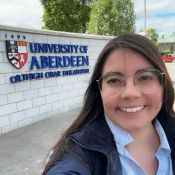
Chasing a Dream
Since childhood, I have been passionate about acquiring new knowledge and, over the years, I discovered Intellectual Property Law as a fascinating field that connects creativity, innovation, and legal frameworks. However, I knew that in order to grow professionally, I needed education of an international standard. That is why I decided to take a major step: leaving my beloved Mexico City to pursue my dream of studying a Master’s in International Intellectual Property and Information Law.
The United Kingdom (UK): More than a Destination, a Life-Changing Experience
I chose the UK because its education system is internationally recognised for its excellence, but also because I wanted to experience studying abroad and immerse myself in a culture and language different from my own. Improving and perfecting my English was a key factor in my decision, as it is the global language of communication, essential for Intellectual Property Law, international business, and collaboration with colleagues worldwide.
Aberdeen: Where Tradition Meets Innovation
The University of Aberdeen (UoA) captured my interest from the very beginning. With over five centuries of history and an outstanding cultural and academic heritage, it offers a cutting-edge master’s programme designed to integrate the essential foundations of law with the latest developments in Intellectual Property, Information Technology, Data Protection, and Privacy.
The teaching staff is truly exceptional. They are academics who not only teach but also lead international research, publish influential books and articles, advise governments, and collaborate with global organisations such as the World Intellectual Property Organization. One of the main reasons I felt inspired to study at UoA was their interdisciplinary project, “Sharing the Benefits of the Ocean”, which explores how marine resources can be utilised sustainably and equitably, combining law and marine biodiscovery chemistry. This kind of initiative highlights the University’s commitment to practical and impactful learning that goes beyond the classroom.
Additionally, the University offers a highly personalised approach to education. From the virtual open day events, which allowed me to explore the campus and community, to the direct contact with lecturers and students, I always received quick and helpful responses. On top of this, the University’s excellent rankings, top 15 in the UK according to the Times and Sunday Times Good University Guide, top 3 in Scotland according to the Guardian Guide, and number 1 in Scotland, Wales, and Northern Ireland for student satisfaction according to the National Student Survey, confirmed that Aberdeen was the perfect choice for me.
A Whole World on One Campus
One of the greatest gifts of this experience has been the cultural diversity. Studying in Aberdeen means interacting with people not only from the UK but from all over the world: Thailand, India, China, Japan, Poland, Nepal, Ireland, Russia, the United States, Spain, and many more. These classmates, who have undoubtedly become close friends and colleagues, have allowed me to learn first-hand about different traditions, customs, and perspectives.
Having a supportive group of Latin American friends (from Mexico, Paraguay, and Colombia) has also been invaluable. We share challenges, celebrate achievements, and accompany one another throughout this journey, creating a network of friendships that I know will last a lifetime.
Between Northern Lights and Unforgettable Nights
Aberdeen is a safe, welcoming, and vibrant city. It offers the best of both worlds: a peaceful environment ideal for focusing on studies and a lively social life with cultural and social events, bars, clubs, and beaches. The Aberdeen Sports Village is another highlight, offering modern and affordable facilities for swimming, squash, football, pickleball, badminton, and many other sports.
One of the things I love most is that, due to its northern location, Aberdeen offers the unique opportunity to witness the Northern Lights. Moreover, it is one of the safest cities in the UK, having been awarded the prestigious Purple Flag for its safety and security ten years in a row. For me, as a woman, living in a place where I can feel safe even at night is priceless. On top of that, Aberdeen is significantly more affordable than many other UK cities, which allows me to save money for travelling and exploring other incredible parts of Europe.
Challenges Worth Facing and Growing From
Of course, the journey has not been without its challenges. Being far from home and living on the other side of the world has not been easy, and the cold weather has been quite an adjustment for someone from Mexico City. However, with thermal clothing, a good waterproof coat, and proper footwear, I’ve learned to embrace and even enjoy it. While the long, dark winters can be demanding, sharing experiences with friends and gaining new knowledge makes every day worthwhile. On the other hand, Aberdeen’s summer is absolutely magical, the sun rises as early as 2 a.m. and sets after 10 p.m., offering endless daylight and unforgettable memories.
A Special Thanks Across Borders
Finally, I want to dedicate this space to express my deep gratitude to the Across the Pond team and, in particular, to my advisors. Thanks to their expert guidance, the entire process, from selecting and applying to universities, securing financing through FIDERH, to obtaining my student visa, was much smoother and clearer. Their support was key to achieving my goal, and I wholeheartedly recommend them to anyone dreaming of studying in the UK. Thank you for helping me make my dreams come true!
- Paola
Beyond the Degree: What the UK Taught Me

What the UK gave me was much more than a university degree.
I cannot put into words everything I learned during this year and how transformative it has been for my life.
To be honest, studying in the UK was never a dream of mine. I did not have the financial means, my English level did not make me feel confident, I had no idea how the application process for international universities worked, and, in short, I did not feel good enough to be accepted into a British institution. On top of that, I believed my academic and professional background was not competitive enough to stand out.
My journey began when I decided to start considering the idea of building my own business. I felt I lacked the courage to take that step and that I needed more preparation. That is when the idea of pursuing a master’s degree appeared, a way to fill that gap.
The possibility of studying in the UK came to me when I discovered that many universities offered scholarships for international students, not just tuition discounts. So I started applying to programs in both Australia and the UK. During that process, I received support from Across the Pond, who guided me so well that I ended up focusing all my efforts on the UK. In the end, I applied to four universities, all of them accepted me and all of them offered me a scholarship. I chose the University of Leeds because, besides being the highest ranked among the ones I considered, they offered me 50% off tuition fee and additional financial support for living expenses.
Those two scholarships made possible what once felt out of reach: studying in England. Now, one year later and about to finish, I can say with certainty that this experience has marked a before and after in my life. The master’s degree itself became just a bonus, in the best possible sense, because the real value was everything I experienced along the way.
I met incredible people, built a network I could never have imagined, lived through countless “first times,” improved my English, and most importantly, overcame personal insecurities that had been holding me back. I realized that my profile was competitive enough at an international level, and that I had been ready all along, even when I doubted myself.
I learned so much about myself that today I want to tell you something, especially if you are hesitating about applying for a master’s program: do it. I promise it will be one of the best investments of your life. Because if there is one thing that this year has taught me, it is that opportunities belong to those who dare to take them.
In conclusion, you are just one decision away from living one of the most meaningful years of your life. Give yourself this gift, because no one deserves it more than you. Do it for your past, your present, and your future self.
Wishing you all the best.
- Claudia
A Mexican in the Land of Giants, Studying in Belfast
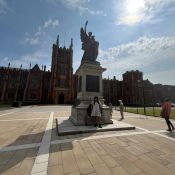
My dream of studying abroad finally came true in the United Kingdom.
I chose this destination because of its academic excellence, its postgraduate programmes with a practical focus, and the cultural diversity it offers. What especially attracted me was the possibility of carrying out an industry project, since it meant an opportunity to experience working in a foreign country. I wanted to have a complete international experience that would challenge me to grow professionally and personally. And it certainly was a considerable challenge: studying another language, adapting to a different dynamic after more than 10 years away from classrooms, and living far from my family for the first time.
Turning Data into Knowledge and Decisions
I am pursuing a master’s in data analytics, and the experience has been fascinating. Analysing information, discovering patterns, applying machine learning algorithms, and predicting outcomes have become a passion. My background is in Computer Science, and I worked for several years as a software developer. Choosing this master’s was a natural step to complement my knowledge and understand how data is transformed into decisions. The course has allowed me to apply my skills in programming, analysis, and visualisation to real projects, while at the same time improving my English.
Returning to the Classroom After More Than 10 Years
I was apprehensive about returning to a classroom, but the experience has been wonderful. Belfast is a lively and fresh city, with clean air and a blue sky that soothe me on my way to class. The university campus is striking; its main building resembles something from Hogwarts: beautiful and enchanting. Living in Northern Ireland has also let me explore unique landscapes, such as the famous Giant’s Causeway, a remarkable place and the reason for my title, “A Mexican in the Land of Giants.”
My Life in Willow Walk
Fortunately, I secured a place at Willow Walk, a highly sought-after residence at Queen’s University Belfast. It is safe and close to the campus, which means I can walk there every day.
The most special part has been sharing a flat with another Mexican of my age, with whom I have built a priceless friendship. Sometimes we cook together, look after each other when we are unwell, and in a way, we have recreated a little piece of Mexico in Belfast.
My First Surprises
Adapting was challenging. I arrived late for the programme, and everything felt overwhelming. The weather was the first thing that surprised me: you can experience all four seasons in a single day. I quickly realised that a small umbrella is useless, and the best investment is a sturdy one. Food also came as a cultural shock: supermarket chillies are not spicy, and the amount of packaged food is enormous. On the other hand, I was impressed by the city’s safety: I could walk at night without fear and carry my laptop or mobile phone without worries.
What I have fallen in love with the most is the warmth of the people. Although I initially struggled with the accent and slang, everyone has been patient and always willing to help.
Thinking in Spanish to Speak in English
The language was one of my greatest fears, as I had never lived in an English-speaking country. But it became an invaluable opportunity to improve.
The university offers academic English courses and one-to-one tutoring. Thanks to these services, and even the help of a professor who has supported me with my writing, I have made far more progress than I ever imagined.
Age Doesn’t Matter, If You Want to Study in the UK: Do It!
Many worries about age, English skills, or money. I did too. But today I can say it is worth it. Yes, there are obstacles, moments of tiredness, and even tears. But all of that is part of a process that makes you stronger. I have grown like never before, proven to myself that I am capable, and I feel fortunate to have come to this welcoming and beautiful city. I hope more people can experience this transformative journey.
My Experience with Across the Pond
I first learned about Across the Pond through Facebook. From the very first email, my advisor guided me patiently and swiftly. I failed the IELTS in my first year, and again in the second. Despite this, I received conditional offers that motivated me to keep going. In the third year, I passed the IELTS and obtained unconditional offers, but then money became the obstacle. I applied for several scholarships, such as Women in STEM and CONAHCYT, but was unsuccessful. My advisor encouraged me to try again. I prepared motivation letters and reapplied. Then I received the news that CONAHCYT had selected me. With very little time to organise the visa, my advisor supported me through every detail until I finally arrived in Belfast one day before the deadline. This process taught me that persistence, determination, never giving up, and proper guidance can make dreams come true even when impossible. I am deeply grateful for Across the Pond's support, which was essential at every step, from the very first emails to my arrival in Belfast.
- Jessica
A space designed for the growth of its students
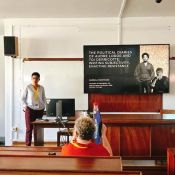
I’ll be honest: I arrived at the University of Nottingham to begin my PhD in Critical Theory and Cultural Studies with a great deal of fear. Although years earlier I had completed a master’s degree in the UK and already knew what it meant to study abroad, the doctorate felt like a much bigger leap—with an entirely different exigency. In a cold January, I packed a suitcase with my warmest coats, a generous supply of Mexican food, and, above all, my fear.
To my surprise, the fear stayed folded away between the clothes. From the very first day, Nottingham showed me that academic rigour does not have to mean exhaustion, and that quality is not synonymous with impossible expectations. Being in a demanding programme also means being in a space designed for the growth of its students: with resources available, with structures that encourage research, and above all, with a community that listens, engages in dialogue, and cares about the development of each of its members.
The University of Nottingham has given me a place to explore my voice, to test my ideas, and to grow as a researcher without losing sight of the human dimension. Here I have discovered that excellence does not suffocate—it inspires; that rigour does not paralyse—it propels; and that fear, after all, can remain in the suitcase.
- Gabriela